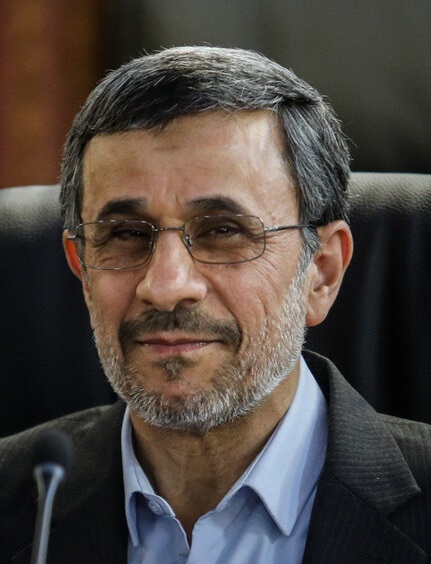
Mahmoud Ahmadinejad's Era: Unpacking the Islamic Revolutionary Guard Corps' Expanded Role
Mahmoud Ahmadinejad's presidency (2005-2013) stands as a pivotal and often controversial chapter in Iran's modern history. His two terms in office coincided with a period of profound shifts, both domestically and internationally, but perhaps none as significant as the dramatic expansion of the Islamic Revolutionary Guard Corps (IRGC)'s influence. While the search term "ahmadinejad gedood aanvallen" (Ahmadinejad killed attacks) might suggest queries about specific incidents of violence or his demise, it is crucial to clarify that there is no credible evidence or widely reported incidents confirming Mahmoud Ahmadinejad was killed or the target of significant, successful attacks during his tenure as president of Iran (2005-2013). This distinction is vital for accurate historical understanding and to avoid misinformation, especially when discussing the often-turbulent landscape of Iranian politics. Instead, Ahmadinejad's era is best understood through the lens of the IRGC's accelerating ascendance as a multifaceted power player within the Islamic Republic.
The IRGC's Ascendance Under Ahmadinejad
Born out of the 1979 Islamic Revolution to protect the nascent Islamic Republic from internal and external threats, the IRGC initially served as a ideological counterweight to the traditional army (Artesh). However, its role began to morph significantly after the Iran-Iraq War (1980-1988), moving beyond purely military functions. Ahmadinejad's presidency, deeply rooted in the principlist faction and with his own background as an IRGC officer, provided fertile ground for this evolution.
Ahmadinejad’s rise to power was seen by many as a victory for the hardline elements within Iran, many of whom had strong ties to the IRGC. His appointments to key government positions often favored individuals with IRGC connections or a shared ideological outlook, systematically integrating the Guards' influence into the state apparatus. This wasn't merely about political appointments; it marked a strategic consolidation of power that reshaped Iran's economic, political, and even cultural landscape. The IRGC, by the end of Ahmadinejad's second term, had firmly cemented its position not just as a military force, but as an indispensable pillar of the Islamic Republic, deeply intertwined with the nation's destiny.
Economic and Political Consolidation: Beyond Military Might
Under Ahmadinejad, the IRGC’s economic footprint expanded exponentially. Exploiting its privileged access to government contracts and its capacity to circumvent international sanctions, the Guards developed a vast business empire. Its primary engineering arm, Khatam al-Anbiya Construction Headquarters, became a behemoth, securing lucrative projects in critical sectors such as oil, gas, infrastructure, and telecommunications. This economic clout not only generated immense wealth for the organization but also provided it with significant leverage over the state's economic policies, often at the expense of the private sector and fostering concerns about corruption and lack of transparency.
Politically, the IRGC's influence permeated every level of governance. Its vast intelligence network allowed it to monitor and control dissent, playing a critical role in suppressing the Green Movement protests that erupted after the disputed 2009 presidential election. Through its Basij volunteer militia, the IRGC maintained a pervasive presence in society, enforcing social norms and mobilizing support for the regime. This consolidation of economic and political power ensured the IRGC's ability to shape domestic policy, influence foreign relations, and protect its institutional interests with unparalleled effectiveness.
Navigating Misinformation: Clarifying "Ahmadinejad Killed Attacks"
The digital age, while providing unprecedented access to information, also presents challenges in distinguishing fact from fiction. The search term "ahmadinejad gedood aanvallen" is a prime example of how misinformation or misattribution can arise. To reiterate, there is no verified information or historical record indicating that Mahmoud Ahmadinejad was killed or was the victim of significant, publicized attacks during his presidential terms. He completed his two terms and remains alive and politically active in Iran, albeit with varying degrees of influence post-presidency.
This often leads to confusion, particularly with high-profile events involving other prominent Iranian figures. For instance, the drone strike that killed Major General Qasem Soleimani, commander of the IRGC's elite Quds Force, in January 2020, was a distinct event of immense geopolitical consequence. Soleimani's death was a targeted operation against a senior military commander, entirely separate from Ahmadinejad himself. Understanding this crucial difference is paramount to accurately interpreting events in the region. For a deeper dive into these distinctions and to clarify common misunderstandings, readers can explore
Ahmadinejad Rumors vs. Soleimani's Death: Clarifying Attacks. It highlights the importance of discerning between the fates of different high-profile figures within the Iranian establishment. Furthermore, exploring the general lack of evidence for such claims concerning Ahmadinejad can be found in
Ahmadinejad 'Killed Attacks': The Missing Web Information, which underscores the necessity of relying on credible sources for sensitive geopolitical information.
Geopolitical Repercussions and Regional Power Projection
The expanded role of the IRGC under Ahmadinejad had profound geopolitical implications. Domestically, its increasing power contributed to Iran's isolation as international sanctions mounted over its nuclear program. Internationally, the IRGC's Quds Force, responsible for extraterritorial operations, intensified its support for various proxy groups across the Middle East, including Hezbollah in Lebanon, Shia militias in Iraq, and to a growing extent, forces in Syria and Yemen.
This projection of power cemented Iran's role as a regional hegemon, often clashing with the interests of Saudi Arabia, Israel, and the United States. Ahmadinejad’s fiery rhetoric and confrontational stance on issues like the Holocaust and Israel's right to exist, coupled with the IRGC's robust presence in regional conflicts, escalated tensions and complicated diplomatic efforts. The Guards’ growing autonomy and influence meant that even subsequent administrations found it challenging to significantly alter Iran's foreign policy trajectory without their implicit or explicit approval.
Legacy and Lasting Impact
The legacy of Mahmoud Ahmadinejad's era, particularly concerning the IRGC, is complex and enduring. His presidency unequivocally solidified the IRGC's position as an indispensable, multi-dimensional force in Iran, far transcending its initial military mandate. It became a powerful political lobby, an economic juggernaut, and a key architect of Iran's regional foreign policy.
Subsequent Iranian presidents have grappled with the challenge of either containing or co-opting the IRGC's immense power. While attempts have been made to rein in its economic activities or political meddling, the Guards' institutional strength and deep integration into the state structure have made such efforts largely symbolic. The ongoing debate about the IRGC's future role – whether it should remain a dominant force or return to a more traditional military posture – continues to shape Iran's political discourse and its relationship with the rest of the world. Understanding this era is key to comprehending contemporary Iran and the enduring power dynamics within its unique political system.
In conclusion, Mahmoud Ahmadinejad's presidency was a formative period that profoundly shaped the Islamic Revolutionary Guard Corps into the powerful, multi-faceted entity it is today. While misinformation regarding "ahmadinejad gedood aanvallen" should be swiftly corrected, the actual story of his time in office is one of significant institutional expansion and consolidation for the IRGC, with lasting impacts on Iran's domestic landscape and its assertive role in regional geopolitics. This era underscores the complex interplay of military, economic, and political forces that define the Islamic Republic.